Coffee, Statute, and a Second Pair of Eyes: How a Nebraska County Certifies Its Vote
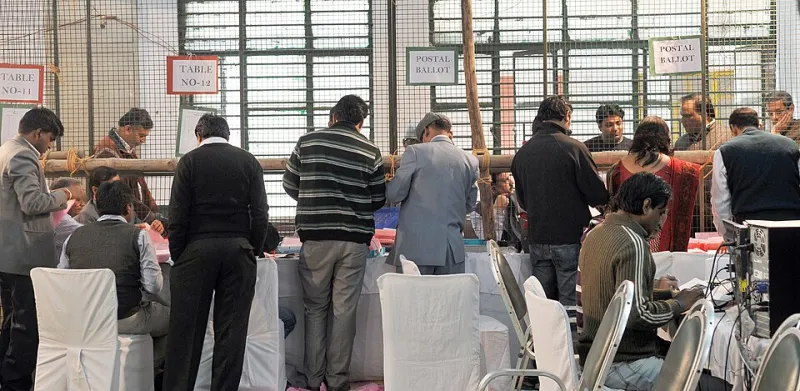
Photo: Election Commission of India, GODL-India, via Wikimedia Commons
There's a stretch of November in every Nebraska county when the election stops being a contest and turns into bookkeeping — and that's meant as a compliment.
The 2026 general election is now nearly two weeks behind us. Unofficial returns have long since stopped scrolling across the bottom of the screen. But the figures that actually become the record — the ones the Secretary of State's office folds into the official statewide tally — get settled at a table in a courthouse, by a small group of your neighbors, in a meeting almost nobody attends.
They call it the canvass. Not a recount. Not an audit. Not a conspiracy and not a cover-up, whatever your feed insists. Just the slow, statutory chore of making the arithmetic official.
Three offices, one folding table
In most of Nebraska's 93 counties, the canvassing board is a three-person affair: the county clerk, the county attorney, and the county treasurer. A handful of counties — Douglas, Sarpy, and Lancaster among them — have an appointed election commissioner who runs elections day to day, and the makeup of the board shifts accordingly. Your county clerk's office can tell you exactly who sits on yours, and the answer is usually posted with the meeting notice.
Worth saying plainly: the three offices are held by three separately elected people, which means three separate political calculations, three separate consciences, and three separate oaths. That's the design. The check isn't a perfectly balanced ticket so much as a room with more than one set of eyes in it — plus the appointed watchers that candidates and parties are allowed to send.
What they're actually reconciling
The numbers you saw on election night were never final. They were a running report from machines and hand-counted precincts, and the canvass is where a county proves its own math.
That means matching poll books against ballots issued, machine memory cards against printed totals tapes, and the count of early and mail ballots against the list of people who requested them. It means tallying write-ins, which in a small county can be a genuinely human exercise — a school board race decided by fourteen ballots where three are legible and one just says "DALE." It means reconciling any precinct where a machine jammed and ballots got duplicated or hand-counted under a judge's watch.
And yes, the totals sometimes move. A few votes here, a few there, occasionally enough to flip a township race nobody was watching. That's not a red flag. That's the system working in the open, which is the opposite of what a rigged count would look like.
The provisional pile
Every county ends election night with a stack of provisional ballots — the ones cast when something about a voter's eligibility needed a second look. Wrong precinct. Name not quite matching the rolls. A registration that didn't get processed in time.
Those ballots sit in sealed envelopes until they can be checked against the state's voter database, cross-referenced for duplicate voting, and judged against the rules for whatever made them provisional in the first place. Some count fully. Some count only for certain contests. Some don't count at all, and the voter gets a letter explaining why. In a tight race, this pile is where the outcome lives — which is precisely why the process is written down and witnessed rather than improvised.
Who's allowed in the room
Short answer: you are.
Canvassing board meetings are public meetings under Nebraska's Open Meetings Act. That means notice, an open door, and minutes. Candidates and political parties may appoint watchers to observe the count, and those watchers have rules to follow — no handling ballots, no hovering over the board, no running commentary.
The rest of us are simply members of the public. Sit in the back. Bring a notebook. If you have a question, save it for the clerk after the session rather than firing it across the table mid-count. Most county officials will happily walk a curious resident through the abstract of votes, and if they can't right then, they can tell you how to request the document, which is a public record.
Watching like a neighbor, not a prosecutor
Here's the honest part. The canvass is dull. There is coffee. There is a lot of paper. Somebody reads statute language aloud and everybody nods.
That dullness is the point. Election confidence in a county of 5,000 people doesn't come from a dramatic reveal. It comes from knowing that the person initialing the tally sheet is the same person who waves at you at the co-op, and that they did it with three other people watching and a written record left behind.
So go in with the curiosity you'd bring to a school board meeting. Ask how the machines were tested rather than implying they weren't. If something genuinely looks off, say so calmly, on the record, to the clerk — that's the difference between a citizen audit and an accusation, and Nebraska counties have long memories for which one you brought.
If you missed it this time
Your county's abstract of votes should be available now or shortly, either at the courthouse or online, along with the minutes of the canvass. Read it once. It's a strange, plain document — columns of names and numbers — but it's also the receipt for your town's democracy.
The next round of local elections will be here before you know it, and there's no better training than having sat through one canvass with a cup of coffee and your mouth shut. County clerks also spend every cycle hunting for poll workers. That's the shortest path from watching the process to being part of it.
Elections in Nebraska aren't run by strangers. They're run by the treasurer who did your neighbor's taxes and the attorney who handled your uncle's estate. The canvass is just the week when they sit down together and sign their names to it.