Counter Culture: How Nebraska’s Hardware Stores Keep Small Towns Bolted Together
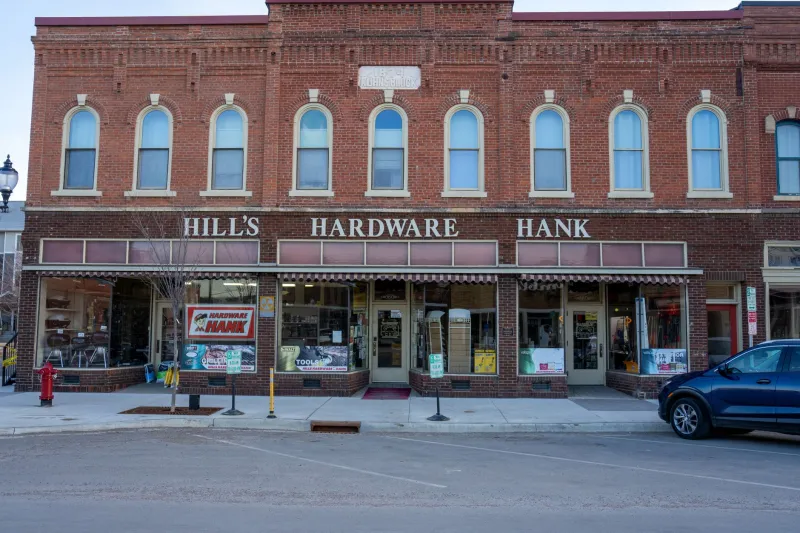
At 7:40 on a Tuesday morning, the coffee at the back counter is already going stale. A farmer in a seed-company cap is explaining a problem with a well pump. The owner, sleeves rolled up, is nodding while sorting through a bin of brass fittings. A younger couple waits near the paint desk with a color chip and a question about primer. Nobody is in a hurry. The phone rings. Somebody hollers from aisle four: “Do you have the little spring thing for a screen door?” The owner hollers back: “Top shelf, left side, in the drawer marked miscellaneous.”
This is not just retail. In dozens of Nebraska towns, the independent hardware store is a civic institution disguised as a business. It is where people go for a furnace filter and leave with advice, a phone number, and a reminder that somebody else has survived the same leaky water heater.
The Counter Is the Classroom
The most valuable inventory in a small-town hardware store is not on the shelves. It is behind the counter, in the head of the person who knows which sump pump fits a 1960s basement, which chain saw bar oil won’t gum up in cold weather, and which local plumber actually answers his phone on a Sunday.
“People come in with a picture on their phone and a look on their face,” said a store owner in north-central Nebraska who has run the same shop for more than two decades. “They don’t always know what they need. They know something is wrong. Our job is to figure out what.”
That kind of help is hard to replicate online. A website can sell a replacement valve. It cannot look at your old valve, ask two follow-up questions, and tell you that the real problem is the shutoff behind the wall. The hardware counter is a classroom where the lesson is practical, the tuition is free, and the final exam is a Saturday afternoon repair.
Advice, Free of Charge
Hardware stores have always been places where expertise is traded alongside merchandise. In rural Nebraska, that role has only grown as other gathering places have thinned out. The local newspaper may publish once a week. The café may close after lunch. The church basement may host potlucks, but not every week. The hardware store, meanwhile, stays open early and closes late and sees nearly everybody at some point.
“You learn pretty quick that you’re not just selling screws,” said a counter employee in a shop near the Platte River. “You’re helping somebody fix a screen door before their mother-in-law visits. You’re helping a young couple figure out why their faucet drips. You’re helping a farmer rig something at 6 a.m. because he’s got cattle out and no time to drive to the city.”
That assistance is not a loss leader. It is the business model. People come back because someone took the time to explain the difference between a drywall screw and a deck screw. They come back because the person behind the counter remembers their name, their project, and the fact that they promised to bring in a photo when the job was done.
A Gossip Corner With Guardrails
Any honest account of the hardware store must include the chatter. The counter is a place where news travels—sometimes faster than the weekly paper. Who is building a new shed. Whose grandson is home from college. Which road is closed. Which committee is looking for volunteers. Which casserole to bring to the church supper.
But the gossip has guardrails. A good hardware store counter is not a rumor mill so much as a community bulletin board with a pulse. People trade information because they trust the room. They also know that the person behind the counter has heard it all and will not repeat the worst of it.
“You hear a lot,” one owner said with a laugh. “You also learn when to say, ‘Well, I don’t know about that.’ That’s a skill.”
That restraint matters. In small towns, reputations are long, memories are longer, and a careless word can travel farther than a winter wind. The hardware counter works because it is a semi-public space where people can be friendly without being reckless.
An Emergency Room With Wrenches
On a practical level, the hardware store is where small emergencies get triaged. A burst pipe. A broken hinge. A snowblower that won’t start. A screen door that has lost its spring. A water heater that is making a noise it shouldn’t. These are not abstract problems. They are the kind of crises that can turn a bad day into a very expensive week.
The store cannot always solve the problem. Sometimes the answer is a part that has to be ordered. Sometimes it is a phone number for a repair person who is booked until Thursday. Sometimes it is a simple explanation: the pilot light is out, the breaker is tripped, the hose is kinked. But even when the store cannot fix it, the counter can usually point a person in the right direction.
That pointing matters. In a city, a homeowner might search online, watch a video, and order a part. In a small town, the hardware store is the search engine, the video, and the part, all in one stop. It is also the place where a person who is new to town can ask a question without feeling foolish.
The Big-Box Shadow
Independent hardware stores in Nebraska do not operate in a vacuum. Big-box stores and online retailers have changed the retail landscape, and many small shops have had to adapt. Some have leaned into services—sharpening blades, cutting keys, mixing paint, repairing screens. Some have stocked harder-to-find parts that the big stores don’t carry. Some have built websites and offer delivery. Some have simply out-neighbored the competition.
But the pressure is real. Rising costs, thin margins, and the convenience of same-day delivery make it harder for a small shop to compete on price alone. The stores that survive often do so because they offer something else: trust, expertise, and a place where people feel known.
“You can’t beat the big store on selection,” one longtime owner said. “You can beat them on knowing what the customer actually needs. That’s the whole game.”
What Gets Fixed
The hardware store counter fixes more than leaky faucets. It fixes the small fractures that can weaken a community—the isolation of a new resident, the frustration of a homeowner who doesn’t know where to start, the loneliness of a farmer who has been in the cab all day. It gives people a reason to walk in, ask a question, and stay for a minute.
That is not a small thing. In a state where distance is a daily fact of life, the local hardware store is a place where distance collapses. It is a civic hub with a cash register. It is a neighbor with a wrench. And on a Tuesday morning, with the coffee going stale and the phone ringing, it is exactly where a town needs it to be.
So the next time you need a bolt, a bucket, or a little advice, pull up a stool at the counter. You might leave with more than you came for.