Eight Strands and a City Council: The Quiet Ledger Behind Nebraska’s Holiday Glow
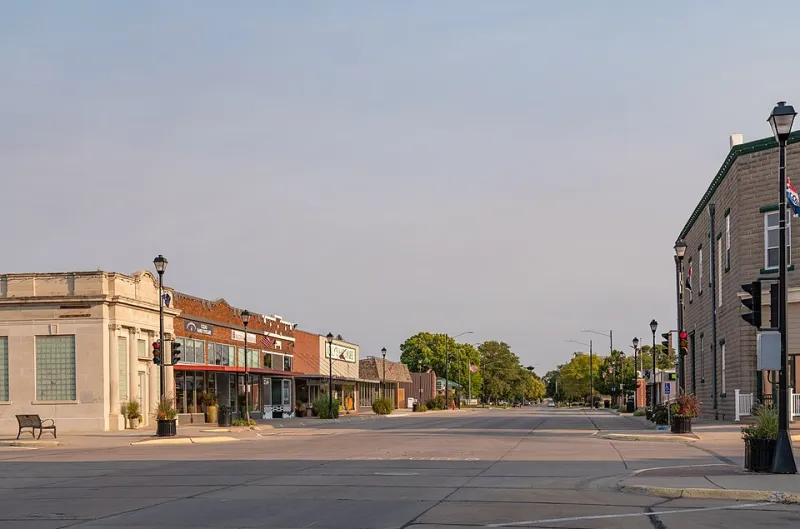
Photo: Tony Webster, CC BY 2.0, via Wikimedia Commons
On the Friday after Thanksgiving, a lot of Nebraska towns will do the same thing at dusk. A few people will stand near the courthouse square or the main street intersection, count down from three, and flip a switch. The trees will turn gold and red. Somebody will clap. A kid will run through the glow. And for a few weeks, the town will look like a postcard that got mailed to itself.
The switch is the easy part. The politics of holiday lights start months earlier, in places where the romance is thinner: a city council agenda, a parks department budget line, a utility account, a shed behind the fairgrounds. That is where Nebraska towns decide how much public money goes toward twinkle, who owns the extension cords, and whether the display at the east highway entrance is worth another winter.
The Bill Arrives in January
Holiday lights are not free, even when the labor is donated. There is the electricity, yes, but also the replacements, the timers, the clips, the insurance review, and the question of who climbs the ladder. In some towns, the city parks department handles the display and the municipal utility absorbs the cost as part of its community budget. In others, a chamber of commerce raises money, a rural electric cooperative pitches in a bucket truck, or a service club quietly pays the bill.
That mix is where the civic conversation begins. A city council member may ask whether $3,000 for new LED strands is a want or a need. A utility board may note that the display uses less power than a few household dryers, but the overtime for linemen is a real line item. A volunteer may point out that the old strands are stored in a building with a leaky roof. None of these questions are glamorous. All of them decide whether the town glows.
In 2026, the math looks a little different in many places. LED replacements have cut electricity costs, but the upfront price still makes a clerk wince. Insurance and safety reviews have become more formal. And the volunteer pool that once included a retired electrician who knew every outlet on the square is not always guaranteed. The lights are a tradition, but they are also a small public works project wearing a Santa hat.
Who Owns the Tangled Box?
The most Nebraska question about holiday lights might be this: Where does the stuff live the other eleven months? In some communities, the answer is a corner of the city shop, next to traffic cones and snow fence. In others, it is a trailer donated by a local business, or a loft above the fire hall, or a garage belonging to the person who has been untangling strands since the Reagan administration.
Storage sounds boring until you lose a box. Then a town discovers that the nativity scene is in one shed, the star for the water tower is in another, and the extension cords are in a third location known only to a volunteer who moved to Kearney. Good civic machinery includes a label maker, an inventory sheet, and a plan for what happens when the person who knows where everything lives retires.
Some towns have moved toward shared displays. A county seat may lend decorations to a smaller village. A school shop class may repair frames. A hardware store may donate clips at cost. These arrangements are not always written down, which is charming until the year someone asks who is responsible if a strand falls on a parked car. That is when a handshake needs a policy behind it.
The Volunteer With the Bucket Truck
Volunteer labor is the heart of the whole operation. Fire departments hang wreaths. Lions Club members string lights along the park fence. A farmer with a front-end loader lifts the star onto the elevator. A lineman from the local utility, off the clock and on his own time, checks the connections. These are the neighbors who make a town feel like a town, and they deserve more than a passing thank-you in the newspaper.
But volunteers should not be the entire plan. A display that depends on one bucket truck and one generous driver is a display with a single point of failure. The neighborly version of civic life is not just asking people to help. It is asking what happens when they cannot. Does the city have a backup? Is there a small budget for a contractor? Are the cords rated for outdoor use? Is anyone under eighteen climbing a ladder in the dark?
Those questions are not a knock on holiday spirit. They are how a community keeps the spirit around for the next kid who runs through the glow. A good display is part tradition, part maintenance schedule, and part neighborly guilt about leaving the tangled box for somebody else.
A Corner Is a Small Promise
Every lit corner is a small promise. The downtown gets lights because the merchants association asked. The highway entrance gets a sign because the city wants travelers to slow down. The courthouse lawn gets a tree because the county owns the space and the maintenance crew knows the outlets. The corners that stay dark usually are not dark out of stinginess. They are dark because no one volunteered, no one budgeted, or no one could agree on who plugs in the extension cord.
That is the quiet politics of holiday lights. It is not usually a partisan fight. It is a negotiation over scarce time, small sums, and public attention. It is a council member saying, 'I love the display, but let's see the bill.' It is a volunteer saying, 'I can hang the wreaths, but I can't store them.' It is a utility clerk saying, 'We can help, but we need a work order.' It is the ordinary machinery of a place that wants to look welcoming in December.
If you want a say in it, the season to speak up is not the night of the switch. It is the budget meeting in summer, the parks board agenda in September, the volunteer sign-up in October. Ask who pays the electric bill. Ask where the strands are stored. Ask whether the display is accessible and safe. Then offer a hand. That is how a Nebraska town keeps the lights on without losing the plot.
After all, the switch gets flipped by one person. The glow belongs to everybody.